


Many Japanese Words with 「気(き)」 🧐
Today, we’ll look at 4 common Japanese phrases that use 「気(き)」 😊
They are all very common in daily life, especially in Japan and Singapore.
If you study Japanese, you’ve probably seen many words that use the character 「気(き)」.
At first, they all look similar and confusing...😵💫
But once you understand the feeling behind each one, they become much easier to use!!
In Japanese, 「気(き)」 often relates to your mind, attention, feelings, or awareness.
Let’s look at some very common 「気(き)」 expressions with simple explanations and examples⬇️
①「気(き)が つきます」 means "to notice or realize something”.
It’s used when you become aware of something you didn’t notice before.
The verb つきます means “to arrive” or “to attach itself.”
Here, it does not mean that you actively do something.
Your awareness comes to you by itself.
That’s why「気(き)が つきます」is an intransitive expression (something happens naturally).
You don’t “notice on purpose.”
The realization suddenly comes to your mind.
That is why we say「気(き)が つきます」not 「気(き)を つきます」.
Example:
「財布(さいふ)を 忘(わす)れたことに 気(き)が つきました。」 💡
“I noticed that I forgot my wallet.”

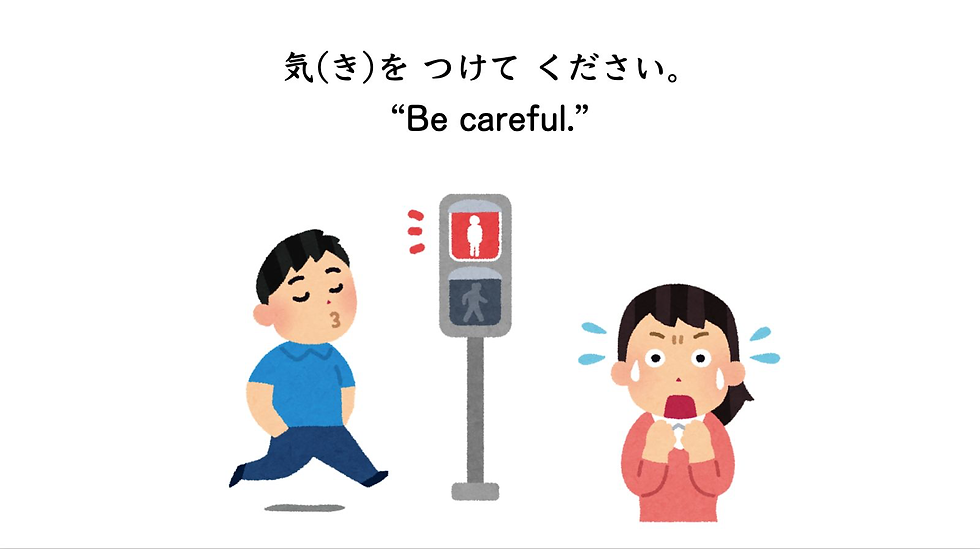
②「気(き)を つけます」 means "to be careful or to pay attention".
You use it when you actively try to avoid danger or mistakes.
The verb つけます is the transitive form of つきます.
It means “to attach something” or “to put something on.”
In 「気(き)を つけます」, you actively place your attention somewhere.
You are making a conscious effort.
Because you do the action, we use 「を」 and a transitive verb.
So, 「気(き)を つけます」 means “to deliberately put your attention on something.”
Example:
「気(き)を つけて ください。」 🚦
“Be careful.”
③「気(き)に します」 means "to worry about something" or "to care about it too much".
It often has a slightly negative feeling.
The verb する means “to do” or “to make.”
In 「気(き)に します」, you are actively making something a concern.
You choose to care, you choose to worry.
That’s why 「気(き)に します」 is a transitive expression.
It often describes a mental action that continues over time.
Example:
「人(ひと)の 目(め)を 気(き)に します。」 😔
“I worry about other people’s eyes.”

④「気(き)に なります」 means "to be curious about something" or "to be a little bothered by it".
The verb なります means “to become.”
In 「気(き)に なります」, your feeling changes into curiosity or concern.
You don’t decide it. It just happens naturally.
That’s why 「気(き)に なります」 is an intransitive expression, similar to 「気(き)が つきます」.
Your mind changes naturally.
Example:
「あの カフェが 気(き)に なります。」 ☕
“I’m curious about that café.”

There are many other words with 「気(き)」, but the key idea is this:
「気(き)」 is about "where your mind is” —what you notice, what you worry about, and what you pay attention to.✨
If you focus on the feeling instead of translating word by word,
Japanese becomes much more natural and easier to understand.😆💡
Sayuri


Comments